What the Crichton Leprechaun Still Teaches Us About Going Viral
I saw the New York Times piece on the Crichton Leprechaun this week and it took me straight back to 2006. If you were around then, you remember it. A local news segment in Mobile, Alabama. A crowd gathered around a tree. An "amateur sketch." A guy with a flute that wasn't a flute.
Ryan Stoner
Brand Strategist · Advisor · Investor
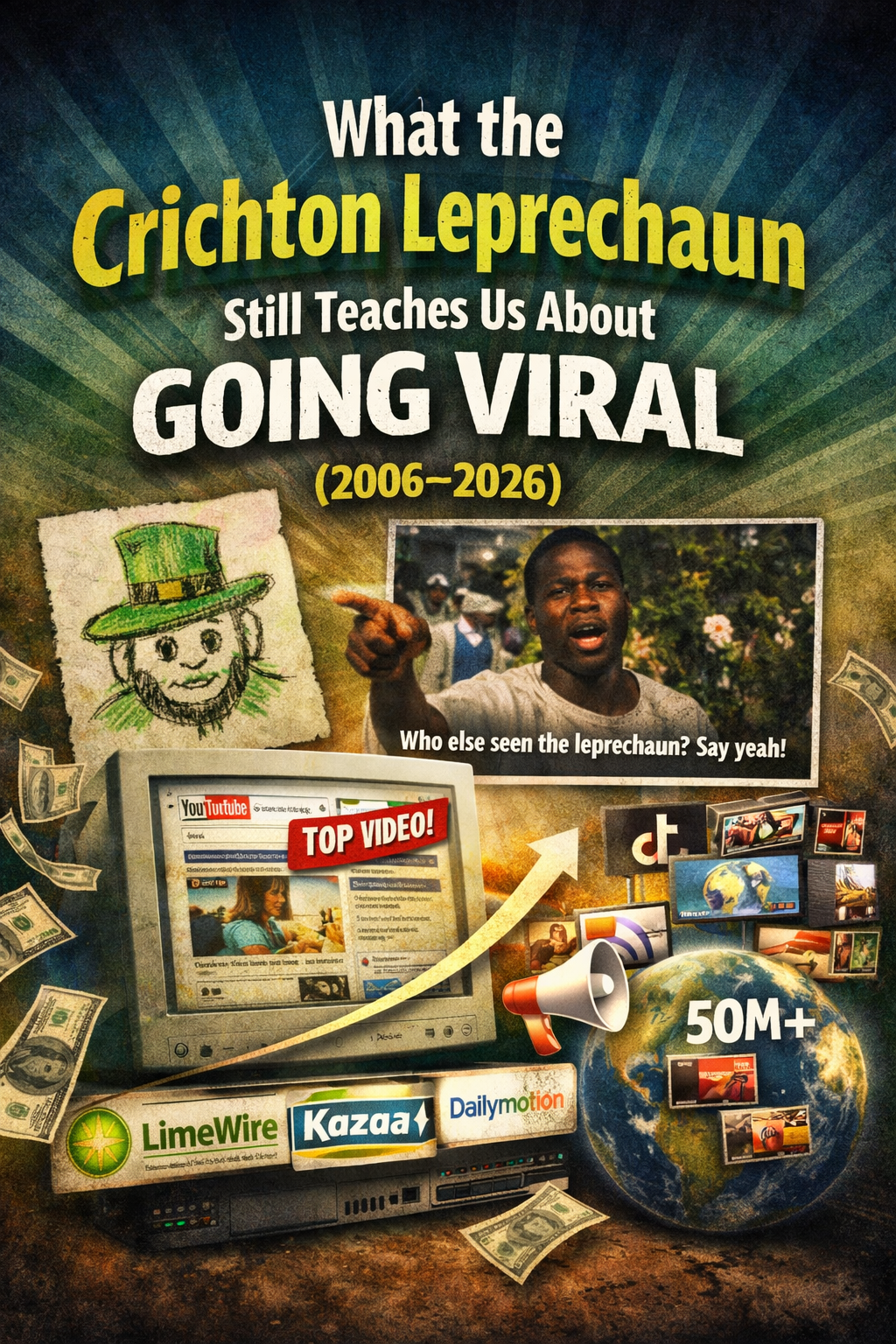
I saw the New York Times piece on the Crichton Leprechaun this week and it took me straight back to 2006.
If you were around then, you remember it. A local news segment in Mobile, Alabama. A crowd gathered around a tree. An "amateur sketch." A guy with a flute that wasn't a flute. It made no sense. That was the point. And it spread everywhere — not because it was planned, but because people couldn't stop sharing it.
Viral is a response. You don't create it. You try to earn it.
Before "Viral" Became a Strategy
In 2006, YouTube was barely a year old. "Viral video" wasn't a playbook yet — it was an outcome. Inside agencies, we were already trying to change that. We built what we called "viral strategies."
- Seeding plans across early influencer networks
- Paid placements on sites like eBaumsWorld and Dailymotion
- Distribution through Limewire, Kazaa, BitTorrent
- Forum drops and blog amplification
We were literally pushing content through Limewire and Kazaa. The idea was simple: if we could inject content into enough "circles of influence," it would spread. Sometimes it worked. Most of the time, it didn't — because we were solving for distribution before we solved for desire.
Throwback, circa 2006
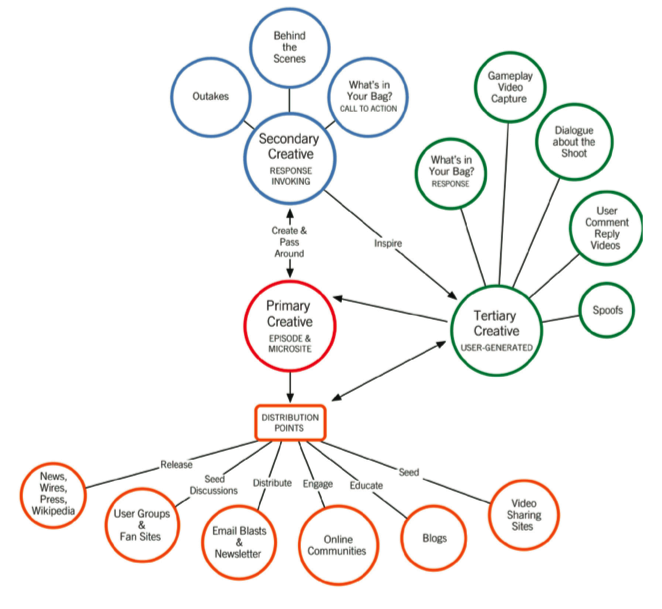
At the time, we built entire playbooks around manufacturing what the Crichton Leprechaun did accidentally. The diagram below is from that era of thinking — a model I developed to map how content could move from a primary creative piece through secondary and tertiary layers of user-generated response. The goal was to engineer the cascade. What we learned: you can build the infrastructure, but you can't mandate the spark.
Viral Is Not a Tactic
Here's the truth most teams still avoid: you don't create viral. You create something people want to pass along. Viral is a reaction. It's what happens when content crosses a threshold.
The Crichton Leprechaun checked all the boxes. It wasn't polished. It wasn't branded. It wasn't trying to sell anything. It was human, weird, and shareable. That's why it worked.
The ultimate goal is to infiltrate enough "circles of influence" — to give people a reason to talk about your product or service. Happy customers are your greatest ads, if you give them something worth sharing.
If your content needs heavy distribution to work, it's not strong enough.
The Playbook Didn't Change. The Scale Did.
Fast forward to today. The mechanics look different — platforms replaced file-sharing networks, algorithms replaced homepage takeovers, creators replaced early influencers. But behavior stayed the same.
In 2006, less than 10% of internet users created content. Today, nearly half do. Distribution is no longer scarce. Attention is.
In 2006, $100K could buy the front page of YouTube. Today, that same level of visibility can cost $2M or more. And even then, it doesn't guarantee anything.
To truly "go viral" now means global saturation — 50 million+ views across multiple platforms. The bar moved. The rules didn't.
People share what makes them feel something. What makes them look interesting. What helps them connect with others. That hasn't changed in twenty years.
The Biggest Mistake Brands Still Make
Most teams still think viral is a media problem. It's not. It's a product problem.
- Over-invest in distribution
- Under-invest in creative
- Confuse reach with relevance
- Try to force scale instead of earning it
If no one would share your content without being paid to, it's not viral. If it doesn't create a reaction, it doesn't travel. The fundamentals were true in 2006. They're true now.
- Entertain people
- Do something unexpected
- Create participation, not just consumption
- Make sharing frictionless
- Give people a reason to talk
Then let go. The audience decides what spreads.
The Real Benchmark
The Crichton Leprechaun video still circulates twenty years later. Not because of a media plan. Because it made people genuinely laugh and feel something. Because it created a shared moment. Because people wanted to bring others into it.
That's the bar. Not impressions. Not CPMs. Not how much you spent to get there.
Read More

Essays on brand, strategy, and the future of growth.
One thoughtful email every few weeks. No noise, no spam. Just ideas worth your time.