

Project Description
Repositioning T-Mobile from a shrinking fourth carrier into America’s fastest-growing wireless company — by making the industry’s worst habits into its greatest competitive weapon.
Brand Context
T-Mobile entered 2013 on the ropes. The carrier was losing subscribers to AT&T, Verizon, and Sprint, bleeding postpaid customers quarter after quarter, and trailing the field in both network perception and brand consideration. The wireless industry operated as a comfortable duopoly-plus-two — where two giants set the rules, and everyone else followed. Contracts. ETFs. Throttling. Overages. Activation fees. These weren’t bugs. For the incumbents, they were features. Revenue streams dressed up as standard practice.
T-Mobile had a real network and real products. What it lacked was a reason to matter.
The Challenge
How do you turn a fourth-place carrier into a cultural force — when your competitors are bigger, louder, and deeply entrenched in every customer’s pocket?
The answer wasn’t to play the same game better. T-Mobile had tried that. The answer was to blow up the game entirely — to name the industry’s sins, claim the moral high ground, and make every carrier move feel like a provocation. Not ads. Actions.
Strategic Insight
The wireless industry wasn’t in a technology race — it was in a power game. And every locked contract, buried fee, and hoarded data gigabyte was a hostage situation the carriers called a service agreement.
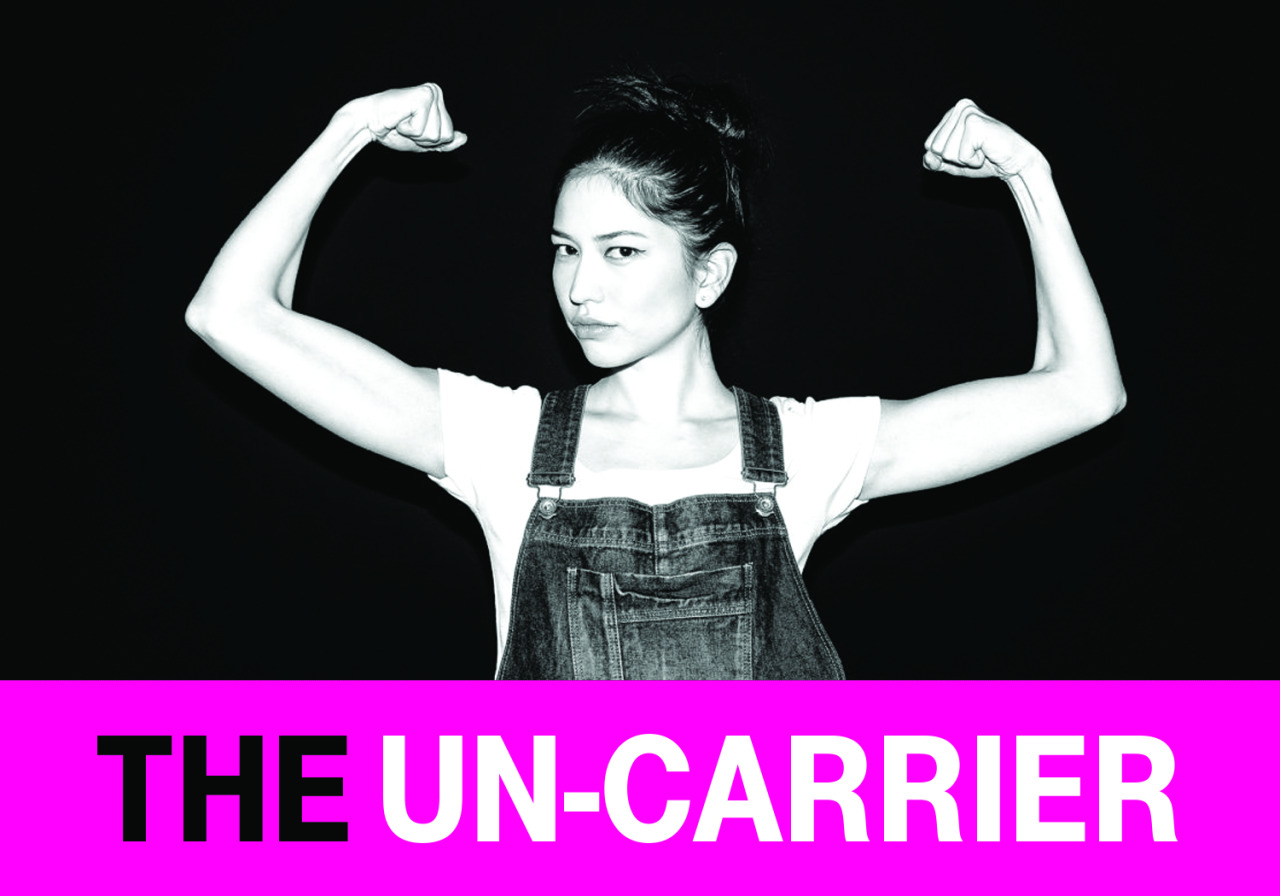
We reframed T-Mobile not as a challenger brand, but as the liberation movement the category deserved. The Un-carrier wasn’t a tagline. It was a governing philosophy — one that made every competitor move look like an admission of guilt.
Creative Execution
My team led brand strategy for a multi-year program of Un-carrier moves, each one engineered as a cultural act as much as a product launch:
-
Un-carrier 1.0 (March 2013): Eliminated contracts. T-Mobile became the first major U.S. carrier to decouple device cost from service cost, giving customers the choice — and making “two-year contract” a phrase that suddenly sounded like a confession.
-
Un-carrier 4.0 — ETF Freedom (January 2014): T-Mobile offered to pay off early termination fees — up to $350 per line — for anyone willing to switch from AT&T, Sprint, or Verizon. It was a direct dare to the competition, launched at CES with maximum visibility. The campaign earned an Effie Award and became a landmark moment in wireless marketing: a brand using its media spend to functionally remove the barriers competitors had built to keep customers trapped.
-
Music Freedom (June 2014): Streaming music — Pandora, Spotify, iHeartRadio — no longer counted against data limits. T-Mobile was the only carrier treating data as a medium rather than a metered commodity.
-
Data Stash (December 2014): Unused high-speed data rolled over for up to one year. Another implicit rebuke to carriers charging customers for data they never used.
-
Binge On (November 2015): Video streaming from 70+ services — including Netflix, HBO Go, ESPN — delivered without touching data allowances. T-Mobile was now the carrier that gave customers more, while the competition figured out how to charge them again.
Each activation was designed to create cultural noise — Super Bowl visibility, Times Square OOH, digital and social amplification — and to force competitors into reactive positions. Whenever AT&T or Verizon responded, it validated exactly what we said about them.
Results
The strategy didn’t just move perception — it moved market share.
-
24 million net new customers added from Un-carrier 1.0 launch through Q2 2016 — more than any U.S. wireless competitor in that period
-
Fastest-growing wireless company in America — five consecutive quarters of 1M+ net additions beginning in 2013
-
8.3 million net adds in 2014 alone — an 89% increase year-over-year, capturing nearly 100% of industry postpaid phone growth
-
ETF campaign became a landmark case in effective marketing, recognized with an Effie Award for driving measurable business results
-
T-Mobile officially became America’s #3 wireless carrier by Q3 2015, passing Sprint
-
Competitor response validated the strategy: Verizon ended annual service contracts in 2015; AT&T and Sprint followed with data rollover plans — moves T-Mobile had pioneered
Reflection
The Un-carrier wasn’t a campaign. It was a commitment made public — one that forced the company to behave differently or be caught lying. That’s the rarest kind of brand work: positioning that changes what a company does, not just what it says. We helped T-Mobile find its enemy, name it clearly, and build a movement that still defines the carrier’s identity today.
Brand Films
Role: Brand Strategy Lead · Publicis Seattle · 2013–2016