Project Description
Building the integrated marketing program that turned the doctor’s office into GoodRx’s next growth engine.
Brand Context
GoodRx had already done something remarkable. It made prescription drug prices visible and negotiable for millions of Americans who had no idea how badly they were being overcharged. The brand was genuinely loved — by patients, by pharmacists, by a growing number of physicians who were recommending GoodRx prices alongside the medications they prescribed.
But by 2023, the category had caught up. Amazon, SingleCare, Cost Plus, Walmart, and the vertically integrating PBMs had all moved into the discount savings space. Price aggregators at point of sale were flattening differentiation. And GoodRx was facing a classic category-defining company problem: you build the map, and then everyone starts using it.
The original value proposition — the cheapest price at the nearest pharmacy — was necessary but no longer sufficient. GoodRx needed a growth strategy that didn’t just win the next claim, but built a competitive moat.
The Challenge
How do you turn the highest-attributed driver of claims — the doctor’s office — into an owned, measurable, and scalable marketing channel?
Price Page Intercept data told a clear story: 25% of claimers heard about GoodRx from a healthcare provider. 16% learned about it in the doctor’s office. Combined, that was the largest attributed source of GoodRx growth — bigger than TV, bigger than search, bigger than friends and family. But GoodRx had no orchestrated program to own it. Historically, HCP outreach had been fragmented across teams, inconsistent in messaging, and nearly impossible to measure. COVID had made it worse.
The moment demanded an integrated, connected, holistic marketing strategy — one that could earn the prescriber relationship, scale across practices, and prove its own ROI.
Strategic Insight
GoodRx didn’t need a new product. It needed a new place — the moment before the prescription reaches the pharmacy.
The reframe: the pharmacy counter was where GoodRx proved its value. The doctor’s office was where GoodRx could build its moat. If we could own the Point of Prescribing — the consult, the kit, the waiting room, the back office, the provider’s own recommendation — we could move GoodRx from a savings tool patients discover to a clinical resource providers depend on. Infrastructure, not alternative.
Creative Execution
I led the Marcom strategy for the Point of Prescribing program — bringing together a cross-functional team spanning creative, CRM, insights, Mansol/HCP, business intelligence, and product marketing. Four moves defined the work:
-
Segmentation that made growth addressable. We built a Power Prescriber framework identifying the top 29.3% of prescribers who drive 86.3% of core claims — with Family Practice, Internal Medicine, General Practice, Urology, and Dermatology as the ten priority practice types. From there, we layered DMA-level targeting by market size, prescriber LTV, propensity score, and kit performance. Houston and Dallas were selected as pilot markets. Total available unmailed NPI leads in remaining markets: 603,912.
-
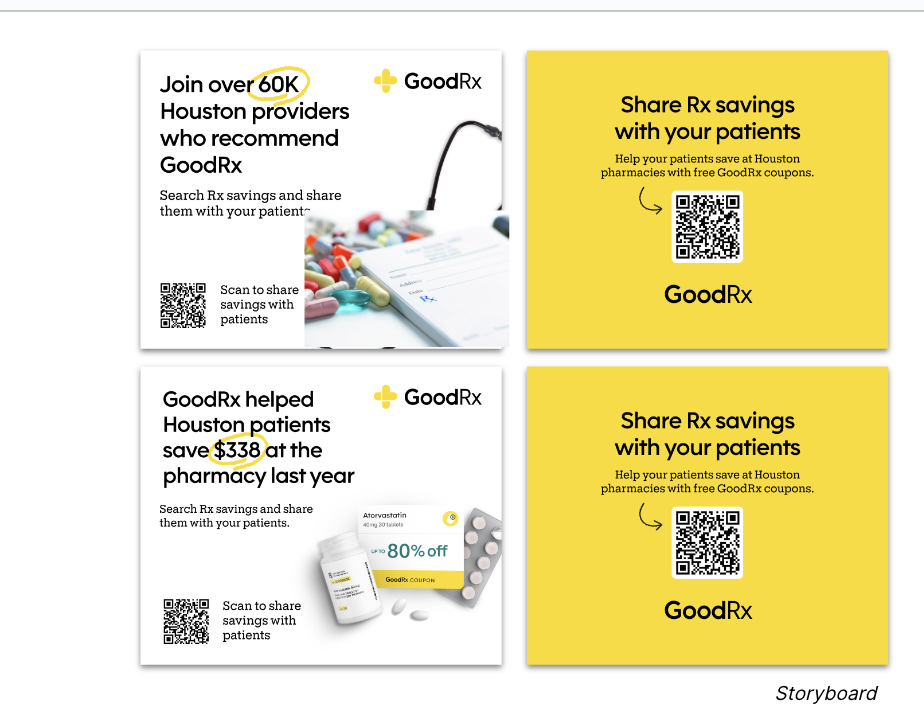
An integrated in-office experience. We built a full omni-channel presence at the Point of Prescribing — digital screens in waiting rooms, exam rooms, and back offices; physical posters with take-ones, counter mats, and counter stands; redesigned kits with customized inserts; personalized landing pages for both HCPs and patients. The Houston and Dallas creative was hyper-localized — “GoodRx saved patients in Houston an average of $338 on prescriptions last year” — turning national scale into neighborhood proof.
-
A connected lifecycle from awareness to advocacy. We designed prescriber and practice journeys across four stages — Awareness & Claims, Product Education, Product Experience, and Boost Adoption — mapping each touchpoint from physical media at PoP through CRM, Provider Mode sign-up, and high-value prescriber nurturing. Same architecture for patient journeys, separately tuned. The goal: build a contactable, engaged audience in the doctor’s office — patients, providers, and office staff — connected through NPI for true attribution.
-
Local partnerships that earned trust where it lives. We activated regional credibility through the Dallas Medical Society and Houston-area Nurse Practitioners — meeting providers inside their own professional communities, not just their inboxes.
At a glance, the pilot shipped: 3 media partners, 4 tests, 2 cities, 2 emails, 1 kit redesign, 2 kit inserts, 10+ video and digital screen assets, 15+ print assets, 4 landing pages.
Results
-
Launched the first fully integrated Point of Prescribing program in GoodRx’s history— going live October 2023 with an omni-channel presence across Houston and Dallas practices
-
Established the segmentation foundation for national rollout — a Power Prescriber database making GoodRx’s highest-value provider relationships, for the first time, contactable and measurable
-
Designed the scalable Point of Prescribing marketing formula applied across DMAs in FY’24 — with the roadmap built to expand into the remaining 603K+ untouched NPI leads
-
Aligned the Rx Marketplace and Mansol marketing teams around a single integrated strategy — solving the internal coordination gap that had held POP investment back for years
-
Built the attribution and CRM infrastructure (connected by NPI) that transformed HCP marketing from a line item into a measurable growth channel
Reflection
The most interesting thing about GoodRx in 2023 wasn’t a product launch. It was the quiet recognition that the brand’s next chapter wouldn’t be won at the pharmacy counter — it would be won in the consult room. The Point of Prescribing program was the infrastructure move underneath the brand promise: clear the way for the best care, starting with the conversation that starts the prescription.
Done right, the doctor’s office isn’t a marketing channel. It’s a competitive moat.
Role: Marcom Lead · Point of Prescribing Program · GoodRx · 2023